

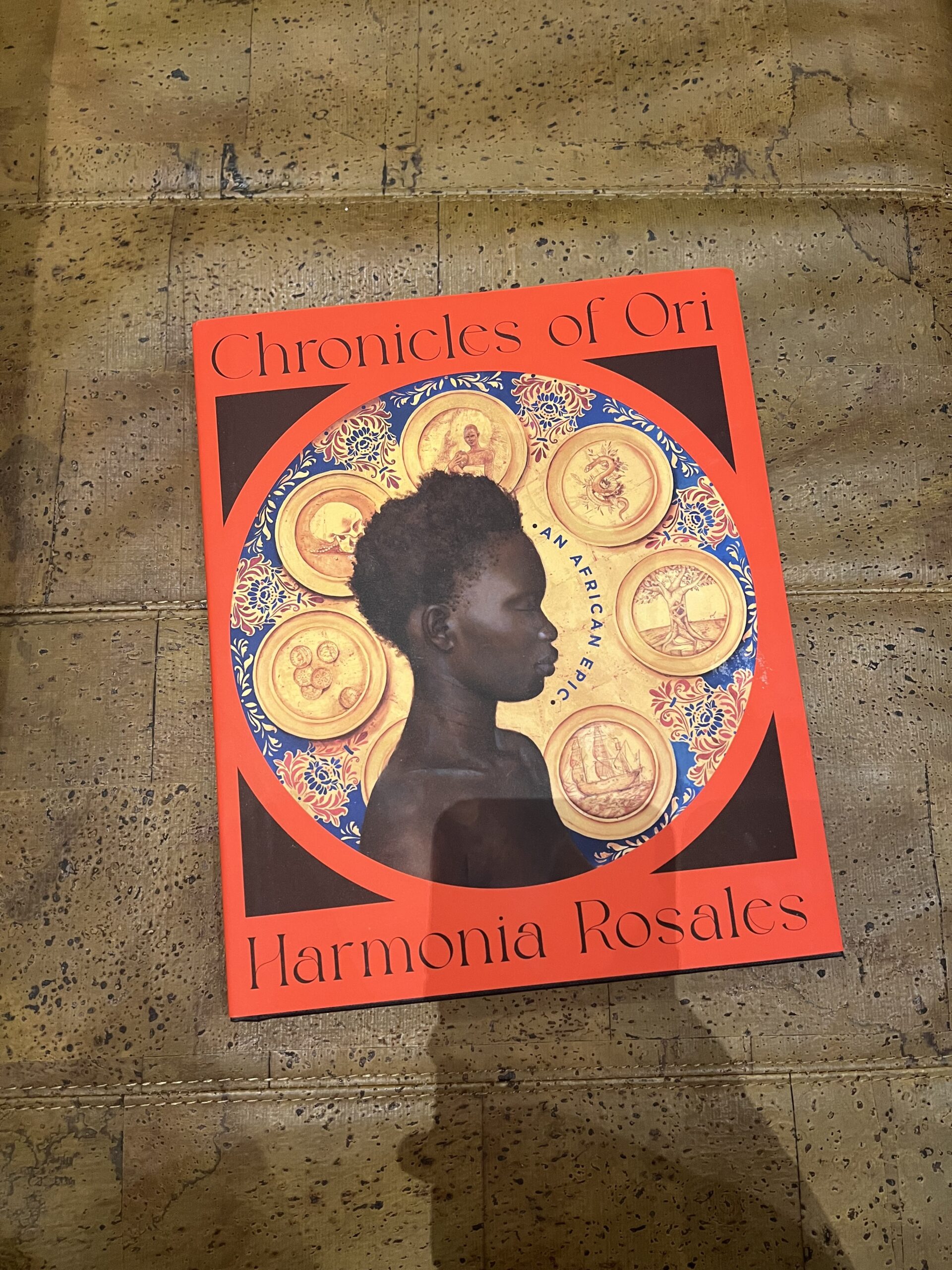
The Perez Art Museum Miami invited Harmonia Rosales in conversation with Desmond Howard to discuss her new book Chronicles of Ori.

This past Sunday I spent my afternoon at the Perez Art Museum Miami to attend a lecture featuring Afro-Cuban American painter and author Harmonia Rosales and former professional football wide receiver and art collector Desmond Howard to discuss Rosales’ new book, “Chronicles of Ori: An African Epic”.
I arrived an hour before the event to explore the Elliot & Erick Jimenez: El Monte exhibition as well as the recently unveiled Woody De Othello: coming forth by day exhibition. But, more on that later.

Chronicles of Ori: An African Epic expounds on Harmonia’s artwork which has focused on the Orishas, the deities of the Yoruba tradition, and their survival across the Middle Passage.
Harmonia, born in Chicago, had early exposure to art at the Art Institute of Chicago through her mother. But it wasn’t until much later at an art exhibit, where her young daughter’s comment about the lack of people that looked like her in Renaissance and Baroque paintings that she was inspired to paint and reimagine those masterpieces with black protagonists.
After her painting, Birth of Oshun, went viral on Instagram due to it’s controversy as it was modeled after Sandro Botticelli’s fifteenth-century panel Birth of Venus, her career began to grow rapidly. Some thought it was genius (it is!), while others were overwhelmed and offended by her audacity. As she began showcasing her work at art shows, she found herself having to explain who the Orishas are (there are over 4000 by the way!) and what they each represented in her work.
“People [from all cultural backgrounds] are like, what what am I seeing? … And I’m here telling them the story, orally, and I have nothing to point them to, because unless you are a part of the culture, unless you have a community you don’t know these stories, all you can think about is what people feed to you, which is the demonizing…all those things. And so I was like, we need some form of … an entry point. And what better than a mythology,” She stated during the lecture.
Her work marries the stories her grandmother passed down to her about the Orishas and her love for renaissance pieces. The book through lots of research, compiling of oral history, and unmasking those hidden under Christian saints tells the story of about seven Orishas to reconnect the diaspora that didn’t know or didn’t have an understanding of them.
“I took the Caribbean versions of the stories and then American history and just tied it into one in order to have a general understanding. I chose about seven Orishas … but just as a starting point, and that’s how the story came about.”

One of my favorite moments of the lecture is when Desmond reveals to the audience he owns one of her paintings, White Lion ,which he purchased after meeting Harmonia at a mutual friend’s house in Pasadena. He was blown away by her work and when he returned home he couldn’t stop thinking about it and knew he needed one of her pieces.
“For me personally, I was like a prisoner of the power of the imagery, the spirituality, and at the same time, the beauty. And I just remember going home … I couldn’t get it out of my mind.” He said.
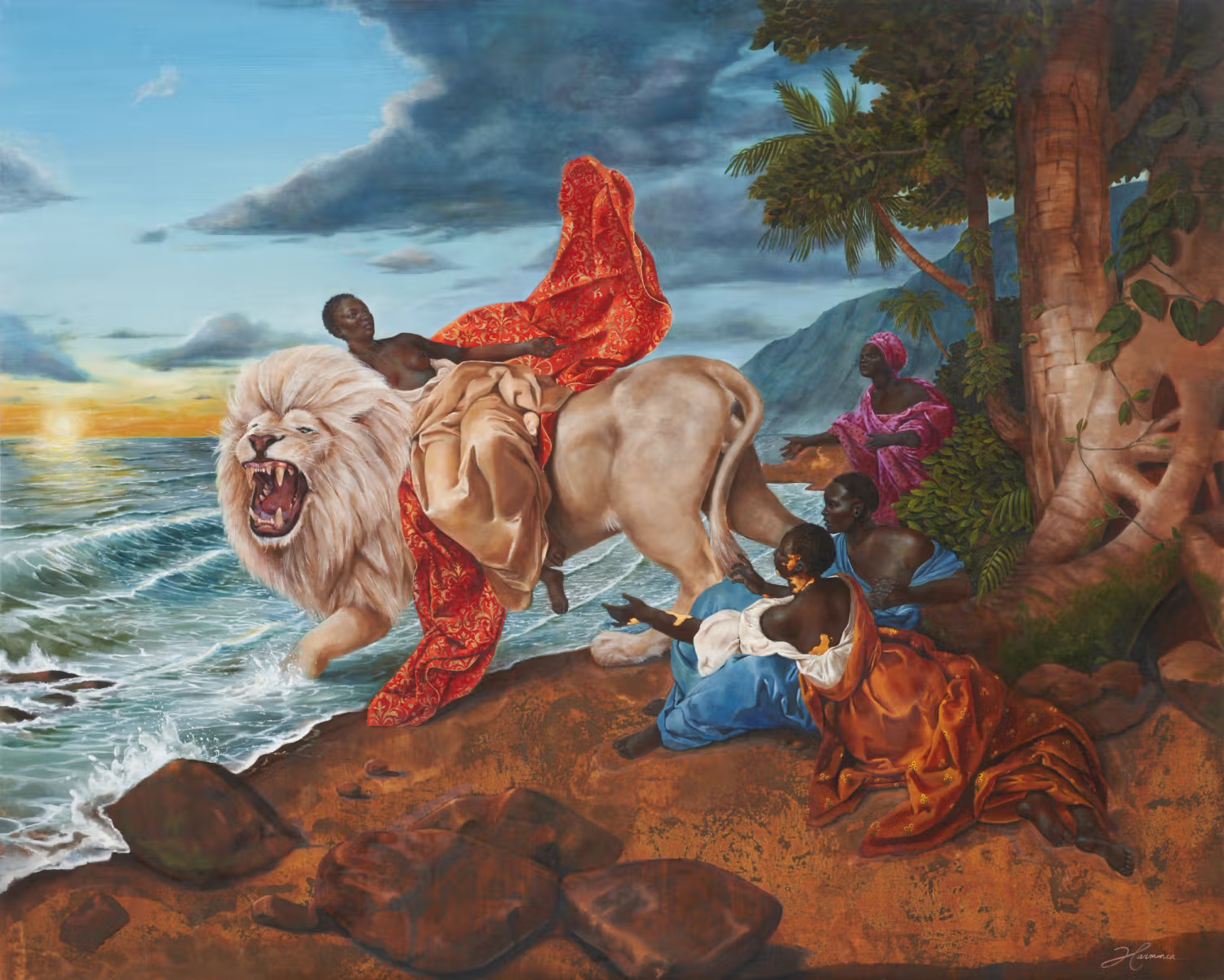
White Lion is truly a powerful piece. I was able to capture the moment when Harmonia explains the piece in detail and exactly what’s depicting. (Note: I apologize about the person’s head in front on me, but the view of Harmonia and Desmond is never obstructed. I hope it doesn’t annoy you too much.)
And saving the best for last, What is Ori? Harmonia defines it as an inner knowing or voice that guides her creative process and life choices. She explains that it is not something easily put into words, but rather a persistent feeling or intuition that tells her what to focus on. It’s similar to an internal guide or calling.
The book is called Chronicles of Ori because it explores the destinies (Ori) of the Orishas and their interrupted journeys across history and culture. “Ori” is a Yoruba concept meaning consciousness and destiny, and the book aims to chronicle these spiritual paths, connect the diaspora with their roots, and reclaim and retell West African mythologies in a way that is accessible and meaningful for a wide audience. The title reflects the book’s focus on personal and collective destiny, cultural reconnection, and the power of storytelling.
This was my very first lecture at the PAMM and I thoroughly enjoyed it. I love absorbing new information and being around likeminded people who love art and design. I’m even thinking about becoming a member of the PAMM at this point. This was my second visit in a month.
Purchase the book here.
If you plan to visit Art Basel at the Miami Beach Convention Center. Harmonia’s work will be on view in Booth D18. I included a screenshot of her IG story below.

With love and gratitude,
Sentrell

Leave a Reply