

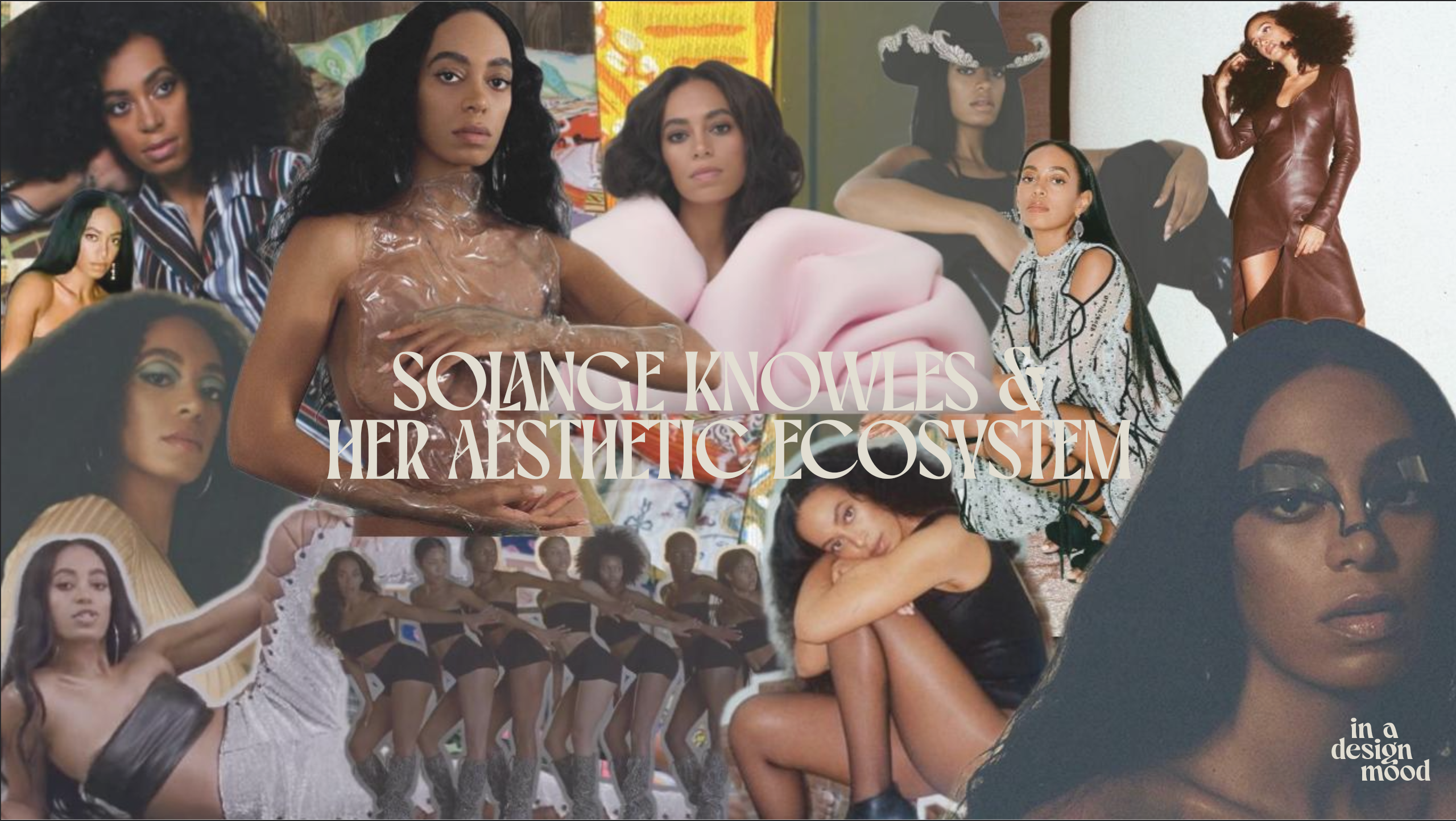
How one artist built an interconnected world of music, objects, space, and spirit, and what it can teach us about intentional living and design.
A NOTE BEFORE YOU READ
This was supposed to be a YouTube video first. I’ve been deep in editing for weeks: pulling footage, sourcing images, watching performances I’ve already watched a dozen times. The research alone has been months. And somewhere in that process I realized I needed to get this idea out, even if the visual version wasn’t ready yet.
So here it is as a written case study first. The video will follow along with another written piece. Consider this the long read before the film.

THE CASE STUDY
There are artists who make music. And then there are artists who build worlds.
Solange Knowles is one of them.
Not because she’s prolific, or because her work crosses disciplines (though it does). But because everything she touches is in conversation with something else. Her music talks to her furniture. Her stage sets talk to her spirituality. Her objects talk to her ancestry. Nothing is decorative. Nothing is incidental.
Today we’re going deep into her aesthetic ecosystem: how Solange has built a world where sound becomes space, where space becomes feeling, and where design becomes a kind of devotion.
If you’ve ever thought of design as just furniture or paint colors, by the end of this, that definition won’t fit anymore. Let’s get into it.
CHAPTER 1: Context & Identity
Solange’s creative path has always been layered. Yes, she’s a Grammy-winning artist. But what’s more interesting to me is how she treats everything (her music, her objects, her spaces, her performances) as part of one cohesive, intentional system. What I call an aesthetic ecosystem.
Let’s break that down.
An aesthetic is defined as a set of principles underlying and guiding the work of a particular artist, concerned with beauty, with how things look and feel and mean.
An ecosystem is a complex network of interconnected elements where everything is in relationship with everything else. Put those together, and you get something more specific than a vibe and more alive than a brand.
An aesthetic ecosystem is an interconnected system of choices across objects, space, sound, material, and culture — that is rooted in a consistent set of values. Not a mood board. Not a style. A worldview, applied with intention across everything you make and everything you inhabit.

I created a diagram to map Solange’s aesthetic ecosystem.
Solange sits at the center.
Around her are the four pillars of her practice:
- Music
- Art & Objects
- Architecture & Interiors
- Spirituality
From those pillars, branches extend outward:
Dance, Visuals, Performance Art, Stage Design, Interior Design, Performance Venues, Glassware, Furniture Design, Fashion, Books, Museum Collaborations, Heritage, Water, Nature, Ritual.
All of it held under the Saint Heron umbrella.
What the diagram shows is that nothing Solange does is isolated. Every branch traces back to a pillar. Every pillar draws from the same roots. That’s what makes it an ecosystem rather than just a body of work. It’s alive, it’s interdependent, and it grows from something real.
Let’s start where she lived.
CHAPTER 2: Interiors & Architecture
Solange’s Hollywood loft has been featured in Apartamento, which, if you know Apartamento, you know is not a magazine that features aspirational spaces. It features lived ones. Real ones. Spaces that tell you something true about the person inside them.

Hers is described as organic modernist: neutral textures, sculptural furniture, Black vernacular art, collected objects from various points of her life. She’s had this space since her late teens (now sold!), and it has grown with her. Each piece, intentional.
And I want to sit with that word, intentional, because it’s easy to use and harder to actually mean. In her Apartamento interview, the interviewer Chloe Sultan gets at what intentionality actually looks like for her, and Solange says this:
“In my home, I definitely have to feel drawn to an object in a metaphysical, spiritual way, where it feels like I can’t live without it. I rely on these objects to teach me things about myself and to reflect things in me that I need to listen to and work on. I really look to all of these as things that I would leave on my own personal altars, or if I were to be gone, what I would want to be a representation of who I was and what I believed in.”
That’s not how most people talk about their furniture. And that’s the point.
Her objects aren’t curated. They’re chosen. There’s a difference. Curation is about what looks right. This is about what means something.
One more thing about the loft worth noting before we move to the stage: geometry.

Solange has a deep, consistent attraction to geometric form: pyramids, spheres, squares, cutouts. It’s not decorative. It runs through her personal spaces, her objects, her visual references. And there’s a biographical thread here too. She was conceived in Egypt, and that connection to Egyptian form and cosmology is something we’ll return to in the objects chapter. For now, just hold it.


Because when you look at her stage designs, the sketches and renderings she’s shared on social media over the years, some of which became full productions and some of which stayed as ideas. The geometry is unmistakable. The pyramid. The sphere. The stepped platform. The cutout. It’s the same visual language as her interior spaces, scaled up to performance size. That consistency isn’t coincidence. It’s authorship.
You can see it clearly in her Sydney Opera House performance of Cranes in the Sky — the stage holds those same forms: pyramidal structures, a sphere, steps. The architecture of the set and the architecture of the building in direct conversation with each other.

And then there’s the Guggenheim, An Ode To, which is maybe the most complete expression of this idea. The building’s rotunda, Wright’s spiral, the way the audience was placed inside the space rather than in front of it. The movement of the performance followed the movement of the architecture. She treated the building like a score.
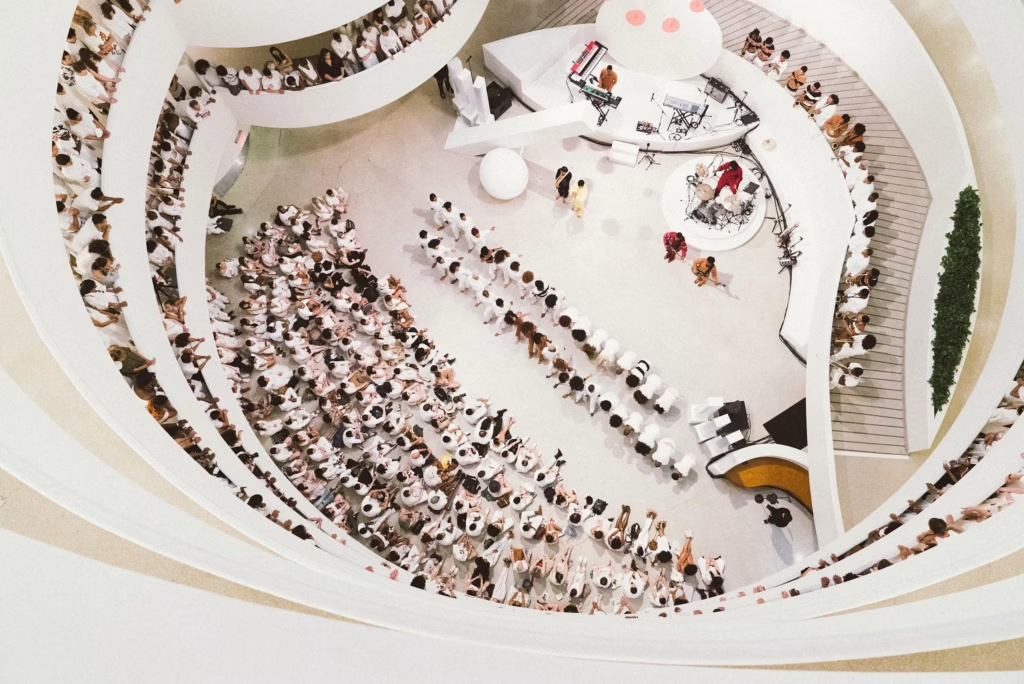
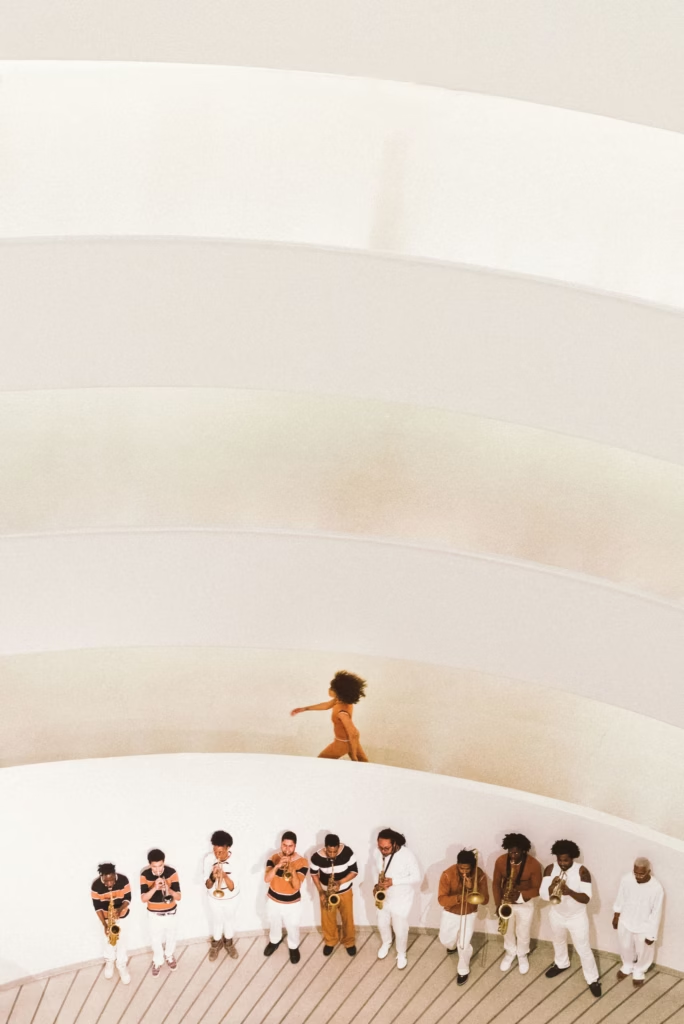
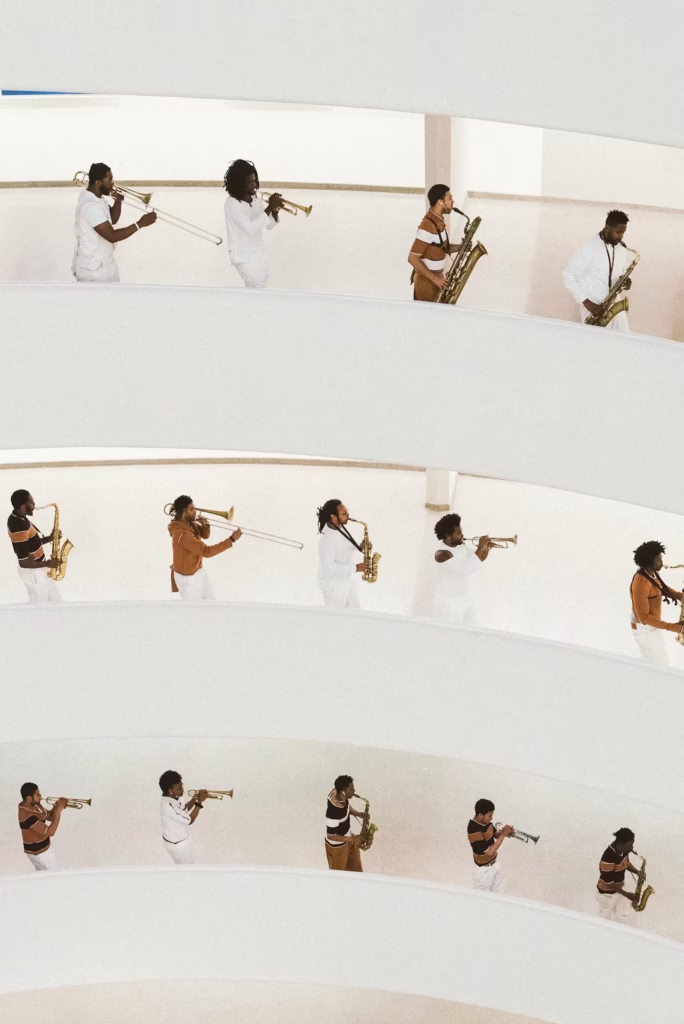
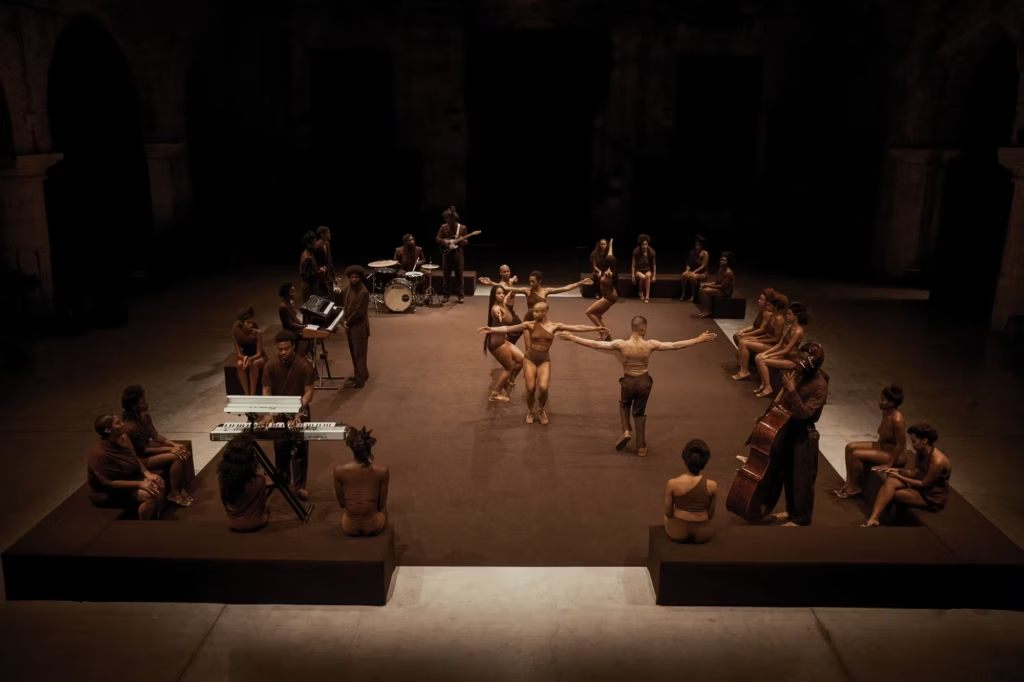


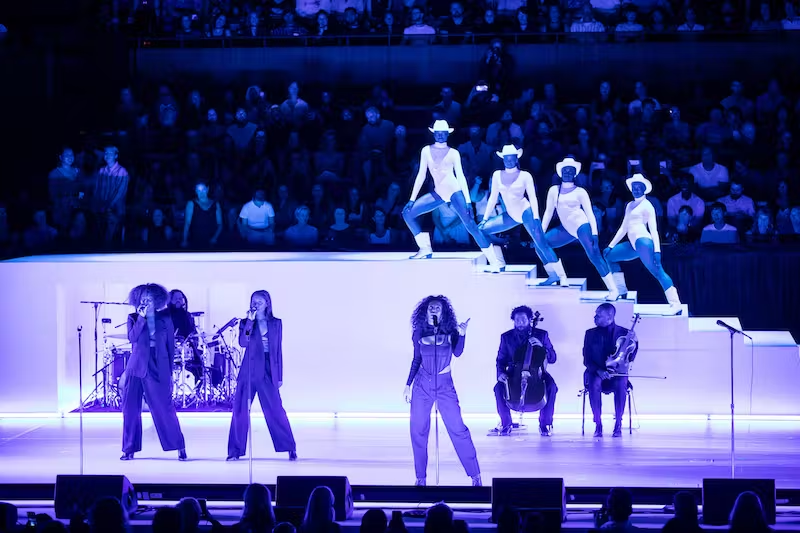
The stage wasn’t a stage. It was landscape. It was altar. It was sculpture.
And we’ll close this chapter in Solange’s own words — because this quote gets at where all of that intentionality actually comes from:
“I remember being a young girl — I started to tour when I was 13, on the road, being in hotels, being in tour buses, being in performance venues. Those were my homes. And so I started to really pay attention to the architecture in these spaces, because that was my sense of groundedness.” – Garage Magazine Bridge-s BTS Video
The intentionality we see in her loft, the way she treats objects as altars. It didn’t come from studying design. It came from needing space to mean something, because space was all she had. That’s the root of the whole ecosystem.
CHAPTER 3: Spirituality, Ritual & Ancestry
Here’s where her practice deepens into something that’s harder to categorize.

Solange’s aesthetic is not rooted in trend. It’s rooted in water. In ritual. In ancestry. In the spiritual lineages of the African diaspora.
Solange loves the water!
Her short film Shakersss.mov, which premiered at the Museum of Contemporary Art in Los Angeles, was described as a moving liturgy of praise, an expression of reverence for self, God, and Yemaya. Yemaya, the Yoruba orisha of the sea, the mother of waters. That’s not a reference dropped casually. That’s a worldview.
This same thread runs through Solange’s engagement with the exhibition Flight into Egypt: Black Artists and Ancient Egypt, 1876 to Now, which was shown at the Metropolitan Museum of Art. The exhibition drew connections between Black American artistic practice and ancient Egyptian form, symbol, and cosmology. Solange moves in that same space — her visual language is in dialogue with myth, memory, and a long historical continuum that most design conversations don’t even approach.
The Apartamento interview makes the personal root of that connection explicit:
”I have both a circle and a pyramid tattoo. I’ve always been attracted to the pyramid, and when my mother told me later in life that I was conceived in Egypt, it made a lot of sense. I started to investigate how the pyramid lines up with a lot of constellations I’ve always felt a strong connection to…I’ve had a lifelong curiosity about Black saints—Saint Heron was actually an Egyptian saint who was martyred…”
What does this have to do with interiors and objects? Everythingggg.
When your design references are not Pinterest boards and trend reports, but spiritual traditions and ancestral memory, you make objects differently. You make spaces differently. The forms carry more weight because they’re asked to do more work.
Solange’s stage sets are not just visual. They’re devotional. Solange’s film frames are not just beautiful. They’re symbolic. And once you see that, you can’t unsee it.
CHAPTER 4: Art, Objects & Fashion
Let’s talk about objects specifically, because this is where Solange gets really interesting as a designer in the literal sense.

Small Matter: Form Glassware 001
Saint Heron’s collection for the MoMA Design Store, Small Matter: Form Glassware 001, is one of the cleaner examples of her crossing fully into the design world on her own terms. She didn’t license her name. She didn’t collaborate from a distance. She took glass-blowing classes. She got intimate with the material. She learned how it moves, how it resists, how it holds light.
And then she made forms inspired by ritual, domesticity, and movement.
“I started to think about the subconsciousness of domesticity and the Black household… a chair is not a chair, a room is not a room… talking about occupying space.” – Elle Glassware Collection Interview


That’s a design philosophy. A chair is not a chair. A room is not a room. These are not neutral objects in neutral spaces. They are loaded with with history, with meaning, with the particular weight of who has been allowed to occupy what space, and on what terms.


Saint Heron’s collaboration with FLOS and the furniture sketches for her own loft operate from the same premise. The object is a vessel that holds ritual, memory, and identity. Objects don’t just sit there looking good. They act.
In the Apartamento interview, she speaks about designing the sofa for the space. It’s same sofa in the Saint Heron NYC showroom shown above.
“Over the last few years, I’ve been figuring out new ways to express my own design language and encompass all of my ideas and ideals into objects. I started working on the sofa for my creative collective, Saint Heron, and the first prototype of it is in the space. I wanted to create a modular piece with different variations, but all starting with the circle, which is very sacred to me.”
There’s a carousel post on the In A Design Mood instagram showing Solange and all the chairs she has sat in over the years.

Solange’s research and sketches on her Finsta
That distinction between an object that looks good and an object that acts — is maybe the clearest way I can articulate what separates Solange’s design thinking from the decorative.
Fashion deserves its own moment here, because it’s where Solange’s design sensibility becomes the most personal and the most immediate. She’s been front row at the shows for years, yes, but that barely scratches the surface of what fashion actually means in her practice.


For Solange, clothing is not styling. It’s sculpture.
What you notice across her looks is a consistent set of formal interests: cutouts that frame negative space as deliberately as any architect frames a window, texture that reads from across a room, drape and movement that make the body feel like a site rather than just a surface. The garments don’t decorate her. They extend her.
And that’s never incidental. Occupying space, as she’s said, is its own statement. In essence, the fashion makes that statement before she’s said a word.
CHAPTER 5: Music, Visuals & Performance Art
Now let’s bring it all together in the work most people know her for: the music and its visual world.
Cranes in the Sky is architecture. The video is spare, controlled, architectural in its stillness. The emotional clarity of the song finds its visual counterpart in geometry, in frames, in the precise use of negative space. It’s not decoration around the music. It’s the music, in a different form.
Almeda is water, ritual, afrofuturism, and nostaligic. The color palette alone is a spiritual statement: those reds and browns and golds that reference West African aesthetic traditions. The choreography is not dancing, exactly. It’s more like ceremony.
Binz pulls it into the domestic: the intimate interior environment, the specific pleasure of a private space, a private joy. Design indoors, in the most personal sense.
And When I Get Home, the director’s cut, is where everything converges. Texas modernism colliding with myth. Houston’s flat light and open land held alongside Afrofuturist symbolism and ancient cosmology. The camera frames become architecture. The dancers become furniture. The light becomes a design element as deliberate as any object in the frame.


When you watch any of these, you’re not watching a music video in the conventional sense. You’re inside a space Solange built. And like any well-designed space, it shapes how you feel while you’re in it.
CHAPTER 6: Synthesis & Takeaways
So what do we actually take from this?
Interiors and architecture are not backgrounds. In Solange’s work, space is always a participant. It shapes the experience, it carries the meaning, it performs alongside everything else in the frame.
Spirituality and ancestry are design sources. Water, ritual, myth, memory. These are not abstract influences. They are formal ones. They determine the shapes Solange makes, the objects she chooses, the way she composes a frame or a stage.
Objects can be narrative tools. The glassware, the furniture, the lighting — none of it is purely functional or purely decorative. It’s doing something. It’s saying something. That’s a higher ask of an object, and a more interesting one.
Maybe the most important thing, is the holism of it. Music, design, space, object, performance, spirituality: in Solange’s practice, these are not separate departments. They are one practice, expressed through different materials.
That’s what an aesthetic ecosystem actually looks like when it’s working. It’s not a mood board or a brand. It’s a worldview, applied consistently, across everything.
If you take one question from this into your own design thinking — whether you’re a designer, or just someone who lives somewhere and wants to feel something in that space — let it be this: what is the ritual in your space? Not the style. The ritual. What objects carry story? What does the room ask of you, and what does it give back?
Solange’s work suggests that those questions are worth taking seriously. I think she’s right.
SOURCES
WATCH
READ
Apartamento Loft Feature — https://www.apartamentomagazine.com/stories/solange-knowles
Glassware Interview, Elle — https://www.elle.com/culture/music/a44211996/solange-glassware-collection-interview/
Wallpaper Feature — https://www.wallpaper.com/design-interiors/glassware-by-solange-knowles-for-saint-heron-at-moma-design-store
When I Get Home Context, WeTransfer — https://wepresent.wetransfer.com/stories/solange-knowles-when-i-get-home
Guggenheim Performance — https://daily.redbullmusicacademy.com/2017/05/exclusive-photos-from-solange-s-glorious-performance-at-the-guggenheim
In Past and Pupils — https://querida.si/solange-in-past-pupils-and-smiles/
Saint Heron Glassware — https://querida.si/saint-heron-glassware-collection/
Tank Magazine Interview — https://magazine.tank.tv/issue-96/talks/solange-knowles
FLOS Feature – https://flos.com/en/us/stories/inside-solange-studio-saint-heron
Vogue Fashion Feature – https://www.vogue.com/article/solange-eldorado-ballroom-series-fashion
EXPLORE
Saint Heron Archive — https://library.saintheron.com/
Saint Heron Glassware — https://manufactured-glassware.saintheron.com/
Solange on Black Planet — https://solange.blackplanet.com/
Solange Daily — https://www.instagram.com/solange.daily/?hl=en


Leave a Reply